
1. Definition & Working Principle
Electromagnetic shielding mesh, also known as EMI shielding metal mesh, is a woven conductive metal material. Following the Faraday cage shielding theory, it creates an uninterrupted conductive barrier to block electromagnetic wave penetration, restrain signal leakage and cut off electromagnetic interference, achieving complete electromagnetic isolation of enclosed spaces.
Three core shielding mechanisms:
Reflection: Free electrons in metal generate reverse electromagnetic fields upon encountering alternating radio waves, reflecting most electromagnetic signals.
Absorption: A tiny portion of permeated waves is converted into thermal energy and dissipated inside the metal.
Grounding Discharge: Full grounding of the mesh eliminates induced surface charges to prevent secondary electromagnetic radiation.
Core technical rule: The mesh hole must be smaller than half the wavelength of the target electromagnetic wave, otherwise severe signal leakage will occur. The entire shielding enclosure must maintain perfect conductive continuity; slits and gaps will sharply reduce shielding performance.
2. Common Material Types & Comparison
(1) Pure Copper Shielding Mesh (Preferred for Shielded Rooms)
Raw material: T2 high-purity copper (99.99% copper content), top-level electrical conductivity among industrial metals
Advantages: Stable high shielding effectiveness (70–120 dB) across 10kHz to 40GHz full frequency band, non-magnetic, soft texture for easy on-site installation
Typical uses: Wall and ceiling cladding of shielding chambers, precision testing labs, military anechoic chambers, MRI medical shielding projects
Standard specifications: 10–200 mesh; wire diameter 0.06–0.4 mm. 40–80 mesh copper mesh is widely adopted for wall construction.
(2) Stainless Steel Shielding Mesh (Cost-Effective Industrial Option)
Raw material: 304 / 316L stainless steel
Advantages: Excellent rust and moisture resistance, high structural strength, lower cost than copper mesh
Drawback: Inferior electrical conductivity, weaker shielding effect for high-frequency signals
Typical uses: Ordinary test compartments, shielding observation windows, ventilation shielding covers for outdoor equipment
(3) Tin-Plated Copper / Brass Mesh
Advantages: Anti-oxidation, anti-tarnish, balanced conductivity and corrosion resistance
Typical uses: Cabinet sealing gaskets, cable shielding, ventilation panels of electronic devices
3. Key Specifications Affecting Shielding Performance
Mesh Count: Higher mesh count equals smaller apertures and stronger shielding capacity. 60–100 mesh is standard for 5G and communication shielding rooms.
Wire Diameter: Thicker metal wires ensure better continuous conductivity and consistent shielding results.
Splicing Standard: Adjacent mesh sheets require a minimum 50 mm overlap, fixed by welding or conductive pressure strips to avoid insulated gaps, a core rule for on-site construction.
Mesh Layers: High-standard shielding rooms adopt double-layer shielding mesh, lifting shielding performance by 20–30 dB.
4. Main Application Scenarios
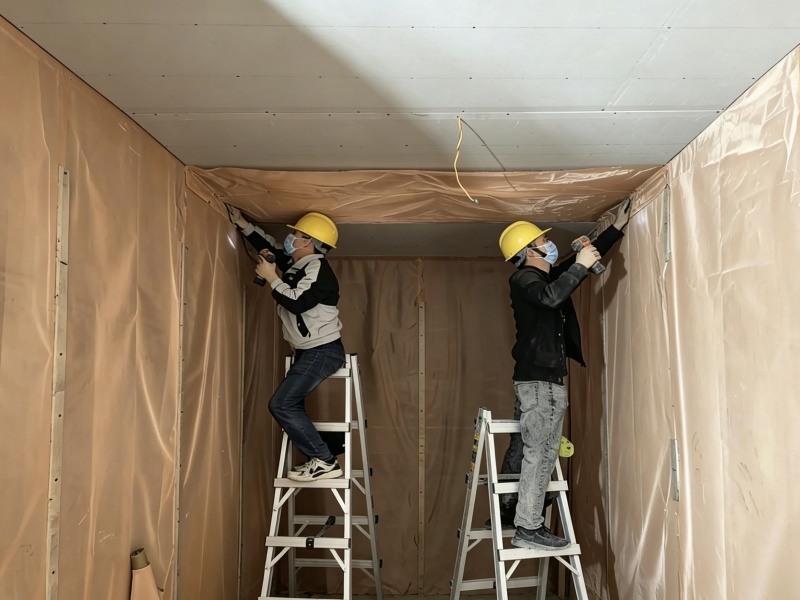
(1) Electromagnetic Shielded Rooms (Matching the Construction Picture)
Pure copper shielding mesh is fully paved on walls, ceilings and floors, combined with metal keels and conductive pressure strips to form a six-sided fully sealed Faraday cage.
Application fields: Communication base station shielding rooms, 5G test booths, confidential computer rooms, EMC electromagnetic compatibility laboratories
Standard construction workflow:
Install metal keels on walls with 600–800 mm spacing
Unfold shielding mesh and overlap panels by over 50 mm
Secure mesh with electric drills and conductive strips; weld all joints to guarantee conductive connectivity
Connect wall, ceiling and floor mesh as a whole and implement independent single-point grounding
Cover the mesh with gypsum boards and decorative surfaces for concealment
(2) Other Application Fields
Medical industry: Isolate external electromagnetic interference for MRI rooms and high-frequency physiotherapy wards
Military & electronics: Shielding cabinets, radar equipment housings, confidential communication cabins
Civil supporting products: Shielded observation windows, ventilation shielding hoods for industrial equipment
Auxiliary accessories: Conductive mesh gaskets to seal gaps of cabinet doors and chassis against signal leakage
5. Critical Construction Specifications
Conductive Continuity: All mesh seams must maintain tight metal contact; plastic separators or insulating adhesive tape are forbidden.
Grounding Requirement: The whole shielding mesh system needs independent lightning protection grounding with grounding resistance ≤ 4 Ω.
Hole & Opening Treatment: Equip pipelines, doors and windows with waveguide ventilation windows or shielding mesh covers to stop electromagnetic leakage from openings.
Surface Protection: Cover installed mesh with gypsum boards and protective films to avoid damage to the internal conductive shielding layer.
6. Shielding Effectiveness Grading
Ordinary single-layer stainless steel test booth: 40–60 dB
Standard confidential computer room (single-layer copper mesh): 70–90 dB
Military high-precision anechoic chamber (double-layer copper mesh): ≥ 100 dB, blocking 99.999% of electromagnetic signals.
Tags: Electromagnetic Shielding Mesh, Electromagnetic Shielding Copper Mesh